

Jane and Michael Frederick, Contemporary Southern Vernacular, Atglen, PA: Schiffer Books.
As soon as I learned that Jane and Michael Frederick had a book coming out, I ordered it. There are assorted packages arriving all the time at my house. A heavy, rectangular cuboid is usually a book, but which one? What emerged this week was Contemporary Southern Vernacular: Creating Sustainable Houses for Hot, Humid Climates.
Before diving into the book, I want to say that I served on the board of AIA with Jane. I was a public director, and possibly the only psychiatrist to hold that position. Jonas Salk was also a public director, I learned when we toured Salk Institute. Jane later served as president of AIA. She is kind, modest, hard-working and visionary — just right for a leader of AIA or pretty much any decent organization. I’m taking a page from her book (ha ha) (from the publisher’s website) to show you how they organize this magnificent work:
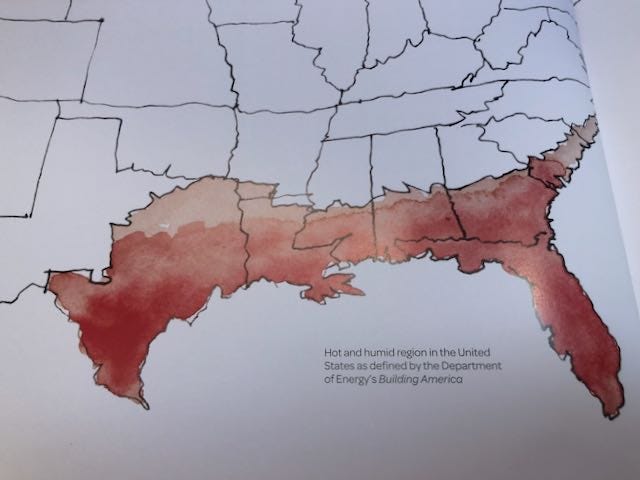
Jane and Michael work in the “hot and humid” part of the country, as they show in this map. I love this image — indeed, all the images in the book are splendid — because it shows me a “set” I’d never named before. I look at the red areas and I can agree — their weather is really different from ours in New Jersey — at least for now!
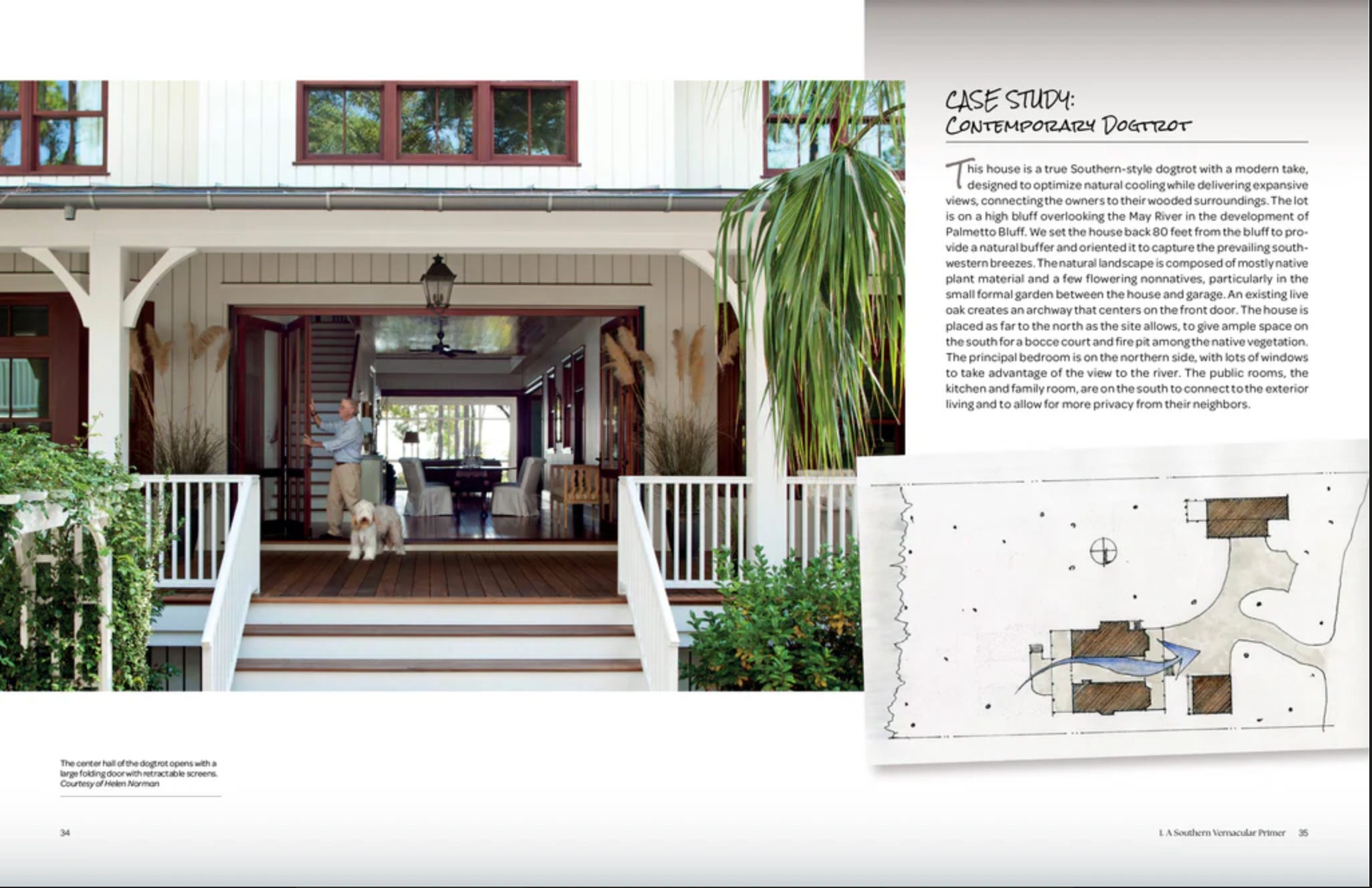
I appreciated that they gave me a geography of the “where.” And then they explain the “what” — that they are working from the vernacular. They open with a quote from Thomas Hubka, who said, “Traditional (vernacular) buildings are summaries of problems already solved.” In this they implicate all the people who have lived in those areas and built houses of one kind or another, the Seminoles, the colonists of many nationalities, the enslaved Africans. All of the groups contributed ideas and distinct forms to create a set of houses that use porches, high ceilings, a careful orientation to the sun, and an awareness of prevailing breeze to manage the heat and to connect to nature. Jane and Michael are taking that pattern language and examining how they and others have employed it in their contemporary designs that are wise in the ways they incorporate energy efficiency and sustainability.
The book is gorgeous, which it’s supposed to be. But it’s not a coffee table book nor is it simply for architects. Jane had talked about her work in such inclusive ways, I always thought I could understand it. And they maintain that throughout the book. They make it clear they know all the technical details, and they also make clear they want readers with and without architectural expertise to enjoy the ideas that they are sharing.
Because they are building on the vernacular, I find their book an important addition to my library on material culture, the ways in which we express ourselves through objects, ranging from our forks to our homes. My friends Jake and Julie got married at a store in Philadelphia called Material Culture. I was chatting with George Jevremovic, the owner, and said I’d read a great book with that title, written by folklorist Henry Glassie. “He is my mentor,” George replied. And that led to a delightful conversation about Turkey and things one might find as one travels the world.
Jane and Michael’s book helps us travel to “hot and humid,” and read the “language” of the houses they have found and others they have built. What a pleasure!
I was driving in East Austin this weekend and thinking about how different the old houses from that neighborhood are in comparison to new construction. That made me think about how there was a time when the shape of things - of housing in this case - was in conversation with environmental conditions, and culture.
In contrast, new construction gave me pause. In some places that new construction is generic in function and shape: you could find that exact housing stock anywhere in the country, in cities with new development. Regardless of the differences in culture, climate and locality.
Thank you for your review of this book. I’m adding that to my thinking.